Hyponatremia patient care plan

Nursing Intervention For Hyponatremic Patient

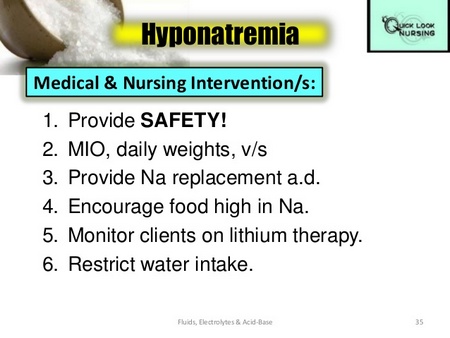
Hyponatremia Patient: A normal sodium level is between 135- 145 mili equivalents per liter (mEq/L). Hyponatremia is generally defined when the sodium in blood falls below 135mEq/L. Severe Hyponatremia is considered when the serum sodium level is less than 125mEq/L. Hyponatremia is frequently related to hypovolemia or fluid overload. Sharp nursing assessment skills and proper […]

Nursing Intervention For Hyponatremic Patient Read More »

Hyponatremia disease

Hyponatremia Disease | Classification of Hyponatremia | Test and Diagnosis of Hyponatremia

Hyponatremia Disease: Hyponatremia disease represents low sodium levels in the blood. The normal level of sodium 135mEq/L- 145mEq/L. When the sodium level < 135mEq/L is called hyponatremia and A level < 120mEq/l is considered severe hyponatremia. The sodium level is maintained by a homeostatic mechanism that involves thirst, antidiuretic hormone (ADH) secretion, the renin-angiotensin-aldosterone feedback

Hyponatremia Disease | Classification of Hyponatremia | Test and Diagnosis of Hyponatremia Read More »

Hyponatremia disease

Hyponatremia Disease | Treatment and Complication of Hyponatremia

Hyponatremia Disease: When the level of sodium in our blood is abnormally low then hyponatremia condition occurred. It should be noted here that, sodium is one kind of electrolyte that helps to regulate the amount of water that’s in and around our cells. This article has shown some important treatments and complications of hyponatremia disease,

Hyponatremia Disease | Treatment and Complication of Hyponatremia Read More »

Hyponatremia Disease

Hyponatremia Disease | Causes and Symptoms of Hyponatremia

Introduction: Hyponatremia is a decrease in the sodium level < 135mEq/L in blood. In the majority of cases, it is occurred by an excess of water relative to solute and some underlying medical reasons, resulting in an electrolyte disturbance where the sodium concentration in the blood plasma is lower than normal condition. Common causes are

Hyponatremia Disease | Causes and Symptoms of Hyponatremia Read More »

Expanded program on immunization (EPI)

Goal of Expanded Program on Immunization (EPI)

Immunization Program:  An expanded program on immunization (EPI) is one of the world health organization programs, which has a goal to make vaccines available to all the children through-out the world. EPI has been delivered the immunization services to the targeted children of below one-year-old and pregnant women. The main objective of EPI in Bangladesh

Goal of Expanded Program on Immunization (EPI) Read More »

Breast feeding to child

Breast Feeding: Benefits and Disadvantages for Child

What is Breast-Feeding? Actually, breast feeding is an unequaled process of providing the perfect food for the healthy growth and development of infants. Also, it is an integral part of the reproductive way with important implications for the health of the mom. A recommendation from global public health– infants must be solely breastfed for the

Breast Feeding: Benefits and Disadvantages for Child Read More »

Wellness or health state

Wellness or Healthy State | Characteristics of Wellness or Healthy State

Wellness or Healthy State Characteristics: Wellness or a healthy state is being in good physical and mental health. It is a lifelong process of becoming aware of choices, also taking decisions toward a balanced and fulfilling life. A healthy state has some characteristics that ensure the ability to live life to the fullest and to

Wellness or Healthy State | Characteristics of Wellness or Healthy State Read More »

Scroll to Top